News
Blog

2026-04-20

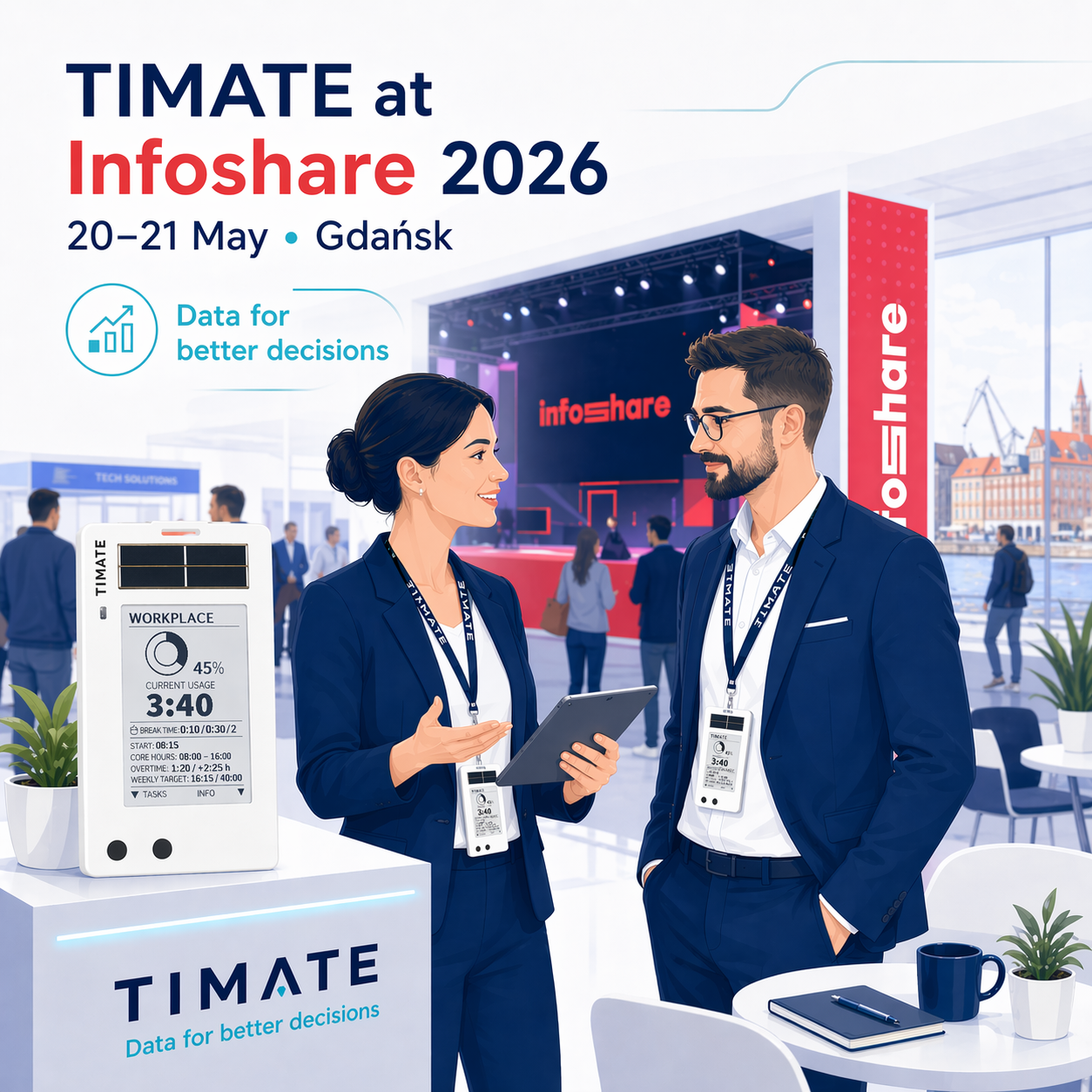
TIMATE at
Infoshare 2026
Data that supports better operational decisions

      On May 20–21, 2026 in Gdańsk, Infoshare will take place — one of the most important technology events in Central and Eastern Europe. It is a meeting place for business, startups, and technology companies looking to develop innovation, build relationships, and explore new directions for growth.

In this year’s edition, TIMATE is also taking part, representing the Silesian Voivodeship. The company’s participation is carried out under the project “InterGlobal – internationalization of SMEs from the Silesian Voivodeship”, implemented within the FE SL 2021–2027 programme, Priority FESL.01 European Funds for Intelligent Development, Measure FESL.01.10 Export Promotion and SME Internationalization.

For TIMATE, being present at Infoshare is an important step toward international growth and an opportunity to show how operational data can genuinely support organizational management. In many companies, day-to-day work is still analyzed only in fragments, and decisions are made based on an incomplete picture of processes. Yet this is exactly where significant improvement potential lies.

During the event, we will show how TIMATE helps transform the course of work into clear information that supports management. This approach makes it easier to understand process organization, identify operational barriers faster, streamline communication, and increase predictability. In practice, this means greater process transparency, better use of resources, and more efficient decision-making.

An important part of the presentation will also be showing how data can support workplace safety organization and coordination in complex operational environments. As a result, companies gain not only a better understanding of everyday operations, but also stronger readiness to respond and improve processes.

Participation in Infoshare is also an opportunity for us to build new relationships, discuss cooperation, and exchange experience with companies that approach growth in a modern, data-driven way.

Visit our booth at Infoshare 2026


2026-04-20

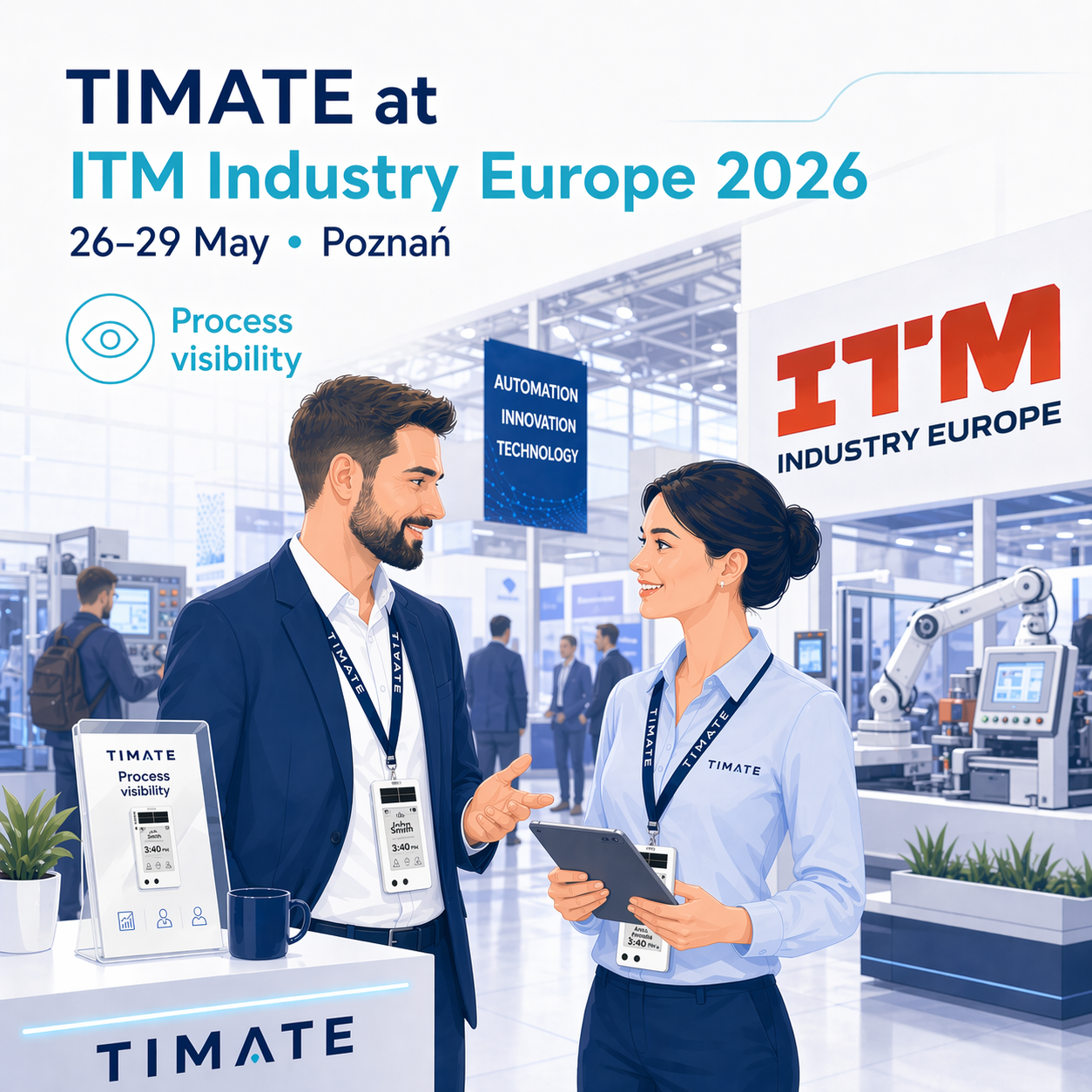
TIMATE at
ITM Industry Europe 2026
Better process visibility in modern industry

      On May 26–29, 2026 in Poznań, ITM Industry Europe will take place — one of the most important events for industry, manufacturing, and new technologies in Poland. It is a trade fair that each year highlights the directions of modern plant development: from automation and robotics to solutions supporting work organization and process management.

TIMATE will also be present at this year’s edition. For us, it is an opportunity to show that the future of industry is not only about machines and automation systems, but also about reliable data on how day-to-day operational work actually unfolds.

In many organizations, this is still where the largest information gap exists. Companies invest in technology, yet still lack a full picture of labor time utilization, process flow, or the points where downtime and organizational disruptions arise. Without such knowledge, it is difficult to plan improvements effectively and build lasting operational advantage.

At the trade fair, we will show how TIMATE helps organize this area. Our solution transforms the course of work into clear operational data that supports day-to-day process management. Thanks to this, companies can better understand labor-hour utilization, identify bottlenecks faster, improve coordination, and plan work organization more effectively.

Another important element will be showing how data supports safety and the organization of presence on site. In manufacturing and logistics environments, not only efficiency matters, but also smooth information flow and readiness to respond quickly in situations requiring good coordination.

We treat our participation in ITM Industry Europe as an opportunity to talk with companies that want to look at processes more broadly — not only through the lens of equipment, but also through the quality of work organization and data-driven decisions. This is the direction in which modern industry is developing today.

Visit our booth at

2025-06-02

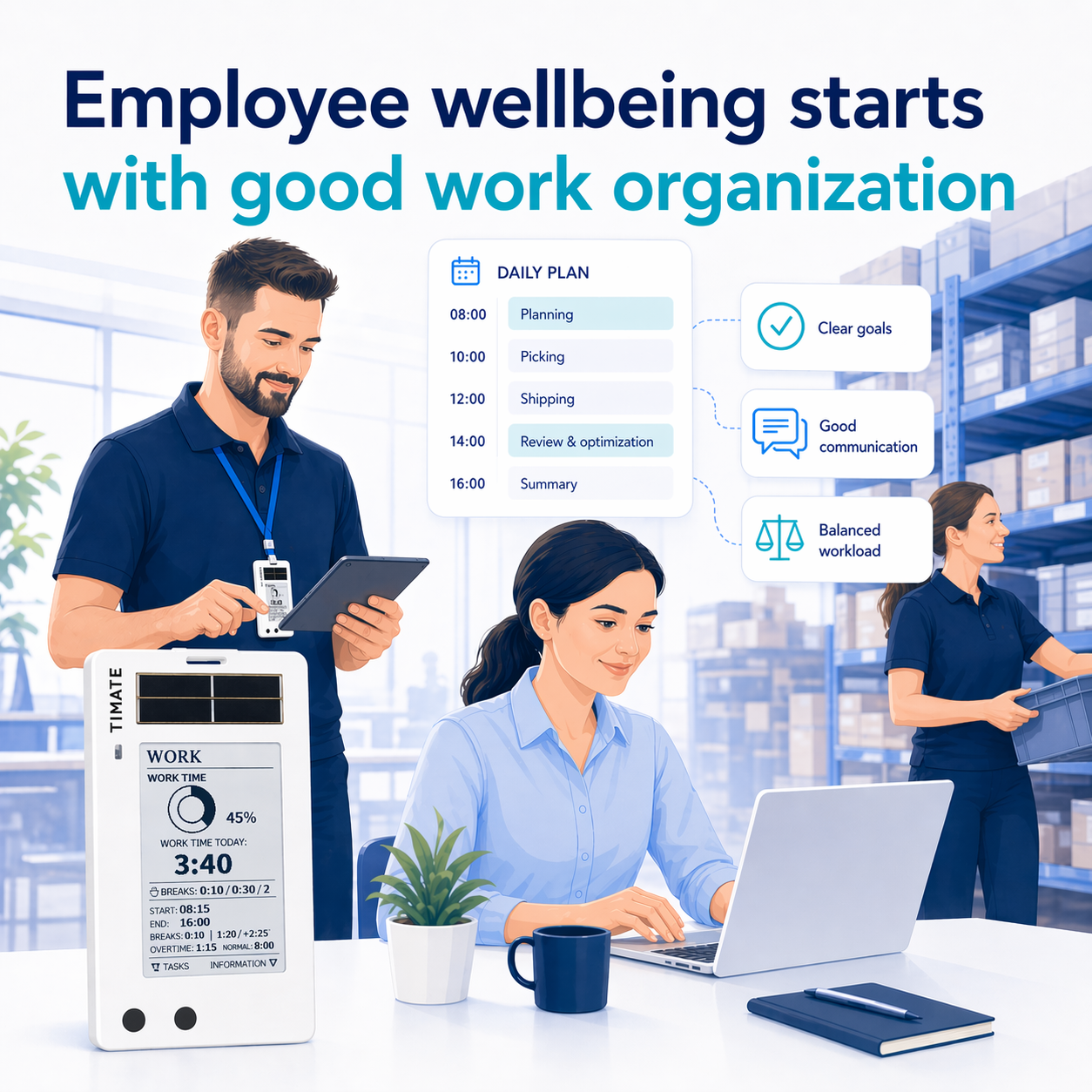
Employee wellbeing starts with good work organization

      In a modern company, employee wellbeing no longer comes only from a package of benefits. Everyday work organization, workload predictability, communication quality, and fast, factual feedback are becoming increasingly important. These are the areas in which an organization builds trust, reduces frustration, and lowers the risk of team overload.

From an organizational perspective, the most important thing today is for work-related decisions to be based on reliable data rather than intuition or isolated observations. Data helps identify where task accumulation occurs, which teams are working under greater load, and which processes require improvement. This knowledge supports better work planning, faster prioritization, and earlier response to issues before they lead to lower quality or team overload.

TIMATE supports this approach by combining working time, communication, and operational data in one system. This allows managers to detect irregularities in work organization earlier, while employees gain clearer access to information about their tasks and the course of the workday. As a result, the company gains not only more predictable processes, but also a better work environment.

For clients, this means very tangible business value: less organizational chaos, less tension in teams, greater operational stability, and higher management quality. Employee wellbeing is therefore not a soft add-on to business. It is one of the conditions for efficient company performance, especially where processes are dispersed, shift-based, and require good coordination.


2024-05-29

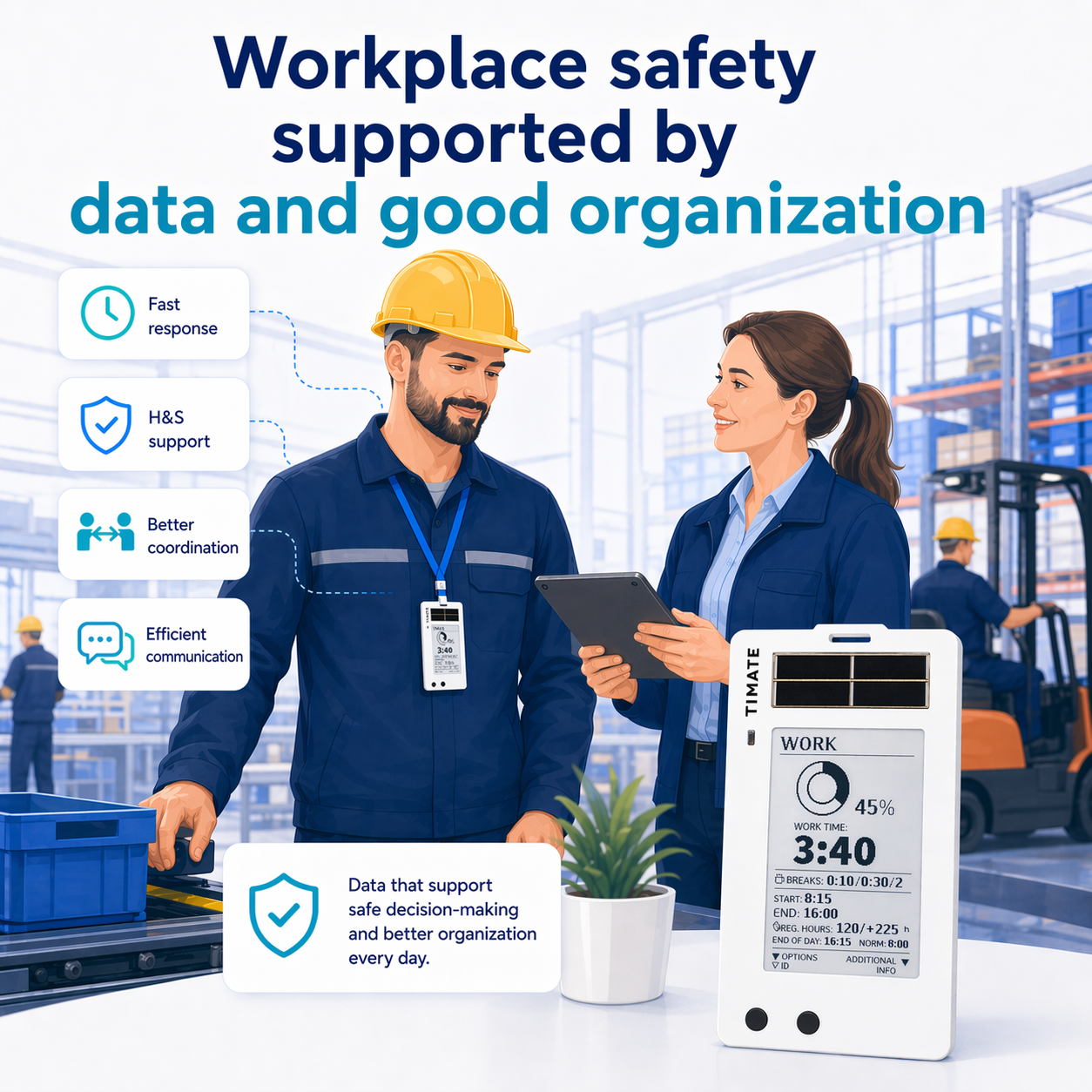
Workplace safety supported by data and good organization

      Workplace safety increasingly requires tools that help identify risk faster and coordinate responses better. In many facilities, traditional H&S procedures remain the foundation, but they are not enough on their own to manage events efficiently in real time. That is why the importance of IoT solutions is growing — solutions that can support safety organization without moving into disproportionate monitoring.

TIMATE’s approach assumes that technology should play a supporting role to procedures and people. The system can support quick responses to selected events, remind users about personal protective equipment, facilitate evacuation organization, and improve information flow in situations requiring immediate action. The key point, however, is that the solution should not replace the employer’s responsibility for H&S, but strengthen their ability to act.

From an ethical perspective, it is equally important to limit data collection to the scope necessary for the purpose. In practice, this means using information in a proportionate and useful way: to protect health, organize work, and improve process safety. This direction is consistent both with employee expectations and with a responsible employer approach.

For industrial, logistics, and warehouse companies, such a model means fewer information gaps on site, better coordination of activities, and greater readiness to respond. For employees, it means a more predictable work environment. And for management, it means the ability to combine safety, responsibility, and efficiency in one coherent operational system.


2023-04-08

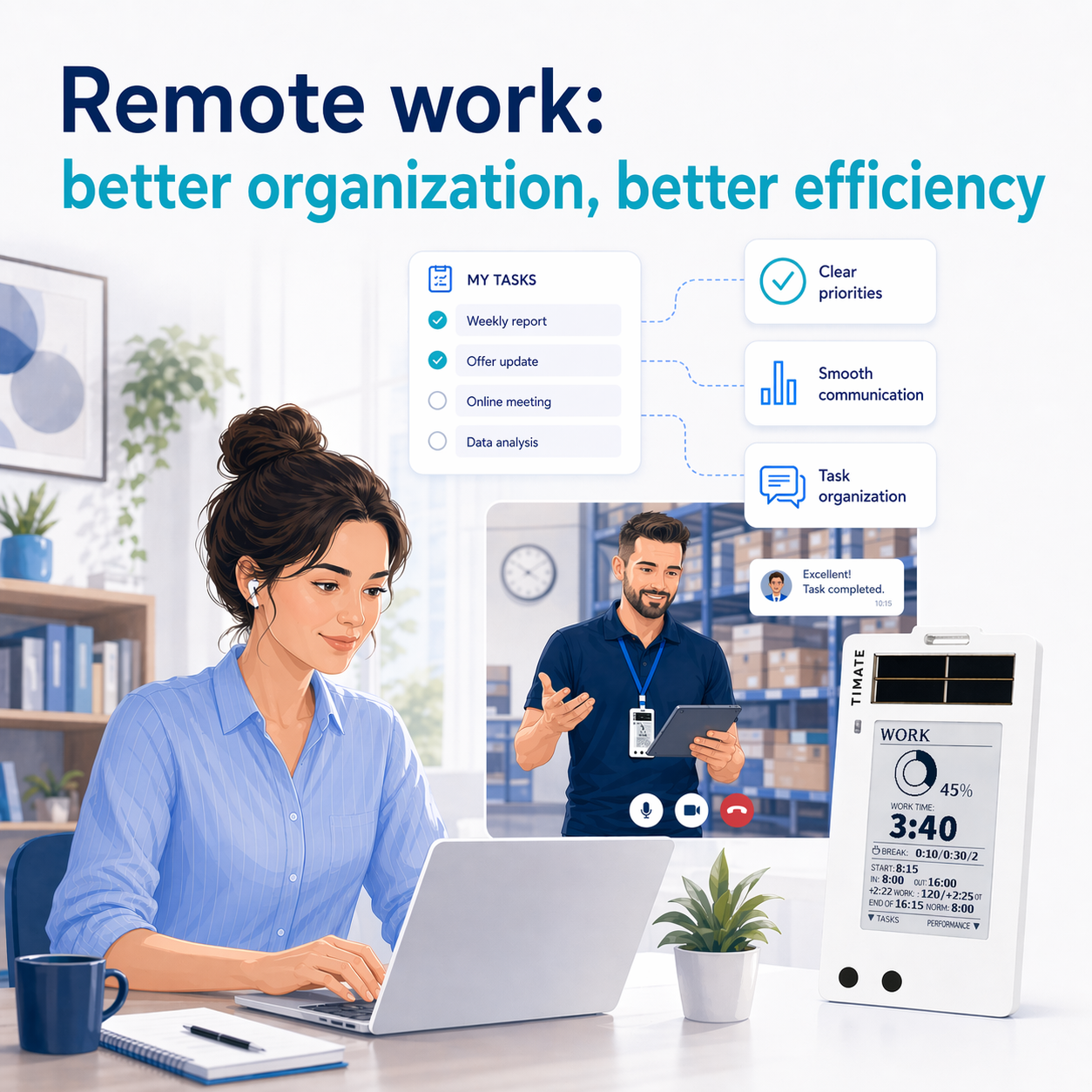
Remote work: how to build efficiency through better organization

      After remote work became widespread, many companies started looking for ways to maintain smooth collaboration, task clarity, and good communication in distributed teams. It quickly turned out that the effectiveness of this model depends primarily on the quality of work organization: clear priorities, transparent division of responsibilities, and good information flow.

The best direction is management based on goals, communication, and clear principles of cooperation. In practice, this means defining responsibilities, deadlines, priorities, and how work results are reported. Such a model organizes day-to-day collaboration, strengthens team autonomy, and supports a stable work rhythm outside the office as well.

TIMATE can support remote work through better information flow, clearer tasks, and greater order in work organization. This is especially important in companies that operate in hybrid models or combine office work with field and shift work. What matters most is that employees have clear tasks, proper support, and access to the information needed to work efficiently, while the company can quickly identify organizational barriers.

From a business client’s perspective, this means a simple advantage: more consistent cooperation, better acceptance of digital tools, and higher management effectiveness. Remote work does not require more complicated mechanisms. It requires better organization.


2023-02-10

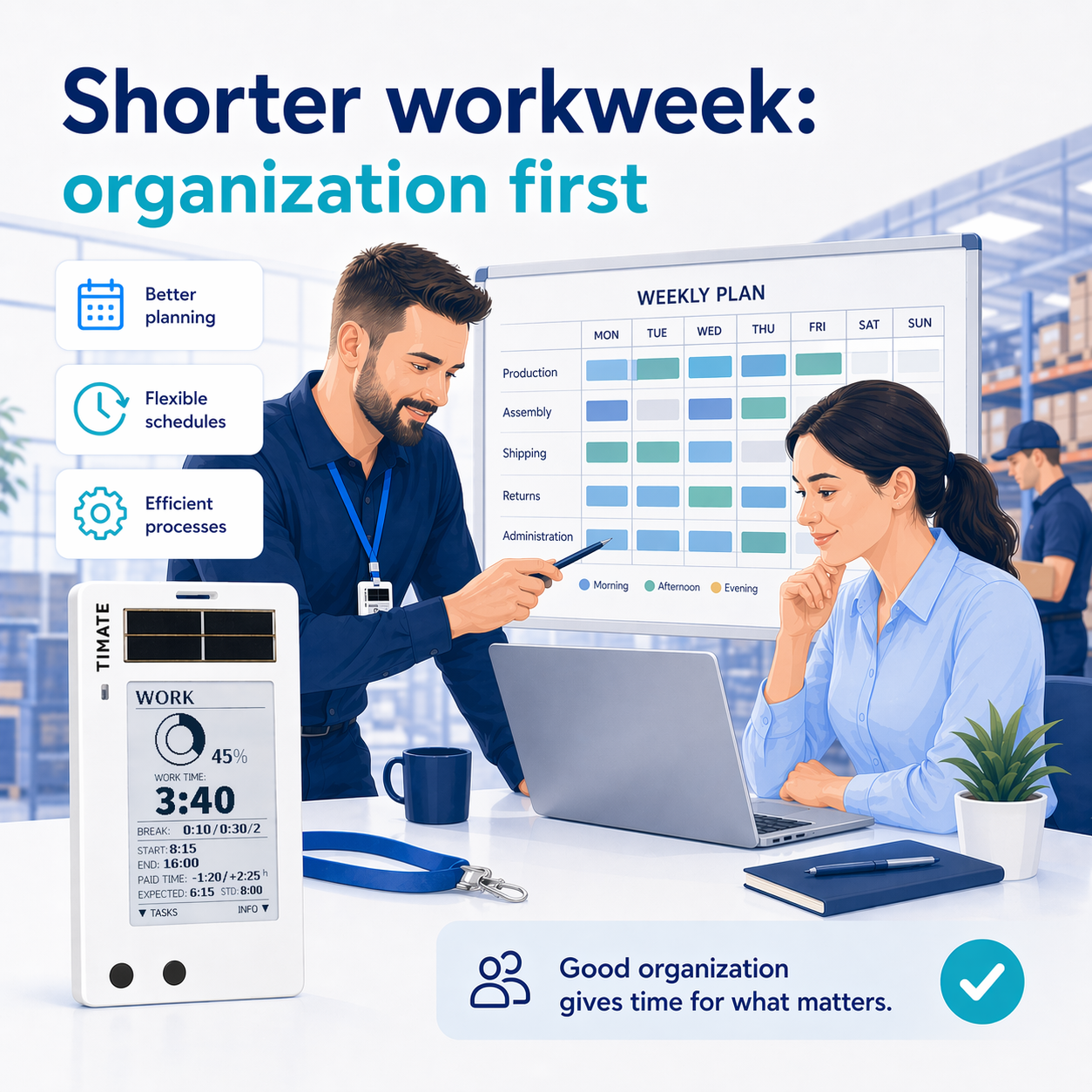
Shorter workweek and reduced working hours: organization first, declarations second

      The discussion around a shorter workweek and more flexible employment models is increasingly moving beyond media debate. For many companies, it is no longer just an image issue, but a real question of how to maintain process efficiency and safety within changing work organization.

The main conclusion is simple: reducing working time can work, but only if the company understands its own processes. Without data on time utilization, team workload, and organizational weak points, it is easy to end up in a situation where fewer hours mean more chaos rather than higher efficiency. Changing the work model therefore requires prior process organization, not just a formal decision.

This is exactly where tools become useful — tools that allow a broader view of work organization: where downtime occurs, which tasks block other activities, where feedback is missing, and which management decisions can be made faster. Data helps design schedules, resources, and communication better, enabling more flexible work models to genuinely support the company.

For TIMATE clients, this is an important direction in thinking about the future of work. Companies that want to implement new employment models responsibly need solutions that support process management, not just attendance recording. It is operational order that allows flexibility to be turned into business advantage.


2022-12-05

IoT implementation step by step: how to make a change that delivers real results

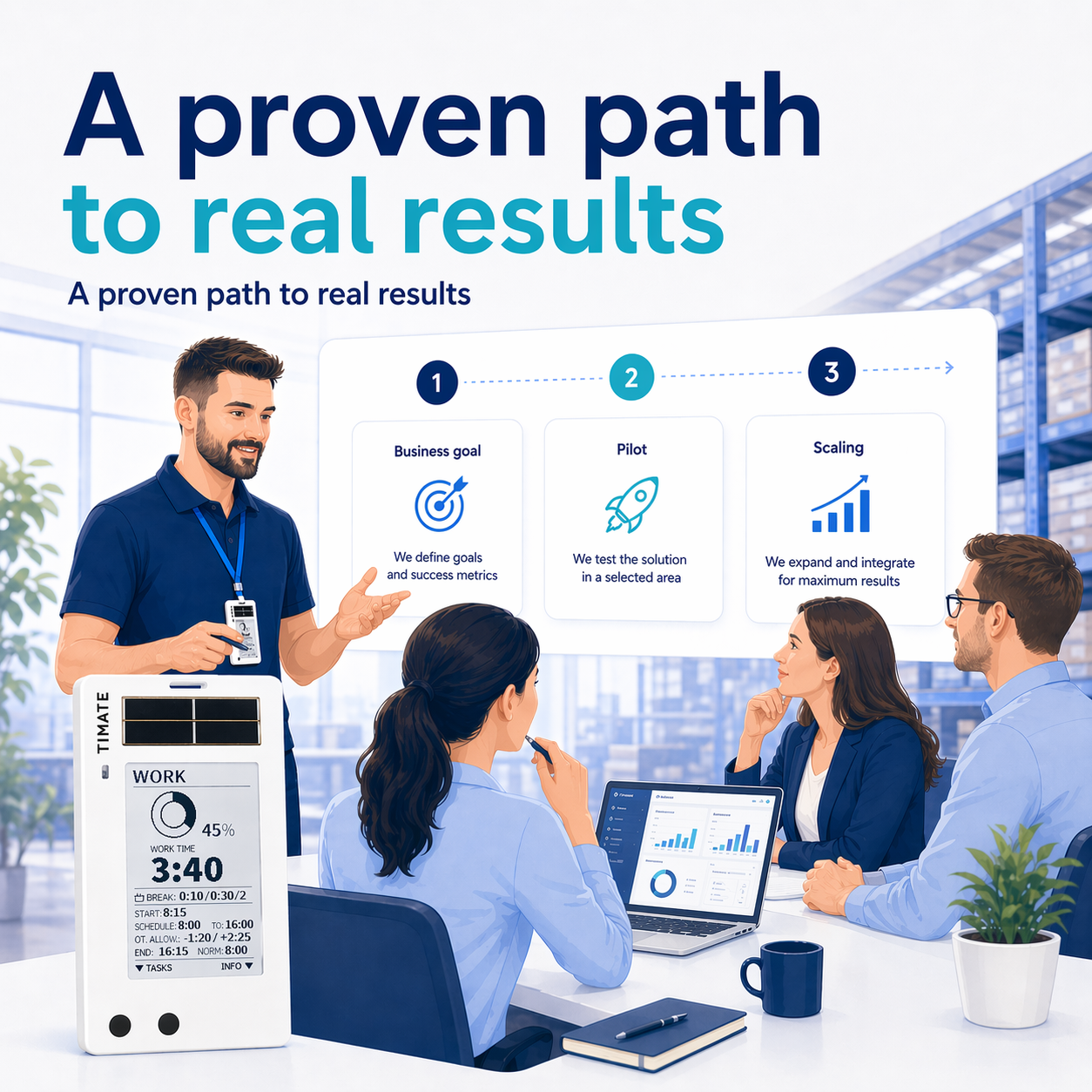
      Implementing an IoT system is not the purchase of a single tool. It is an organizational change project covering processes, people, communication, and decision-making. That is why so many technology projects fail to deliver the expected results: the problem is rarely the technology itself, and more often the lack of a clear goal and proper company preparation.

The first step should always be defining the business problem. Does the company want better work organization? Reduced downtime? Greater process transparency? Improved safety? Only after setting priorities can the right implementation scope be selected. The second step is building a project team that combines operational, technical, and decision-making competencies. Without such a team, the implementation quickly becomes “someone’s” initiative instead of a company-wide one.

The next stage is a pilot and validation of assumptions in a real working environment. At TIMATE, this moment is especially important: the technology must work in the client’s natural processes, not just look good in a presentation. Only after checking which data is truly useful and which organizational changes create value can the solution be safely scaled.

From the client’s perspective, this means lower investment risk and a greater chance of project return. The best IoT implementations do not start with devices. They start with well-formulated questions about company organization.


2022-09-12

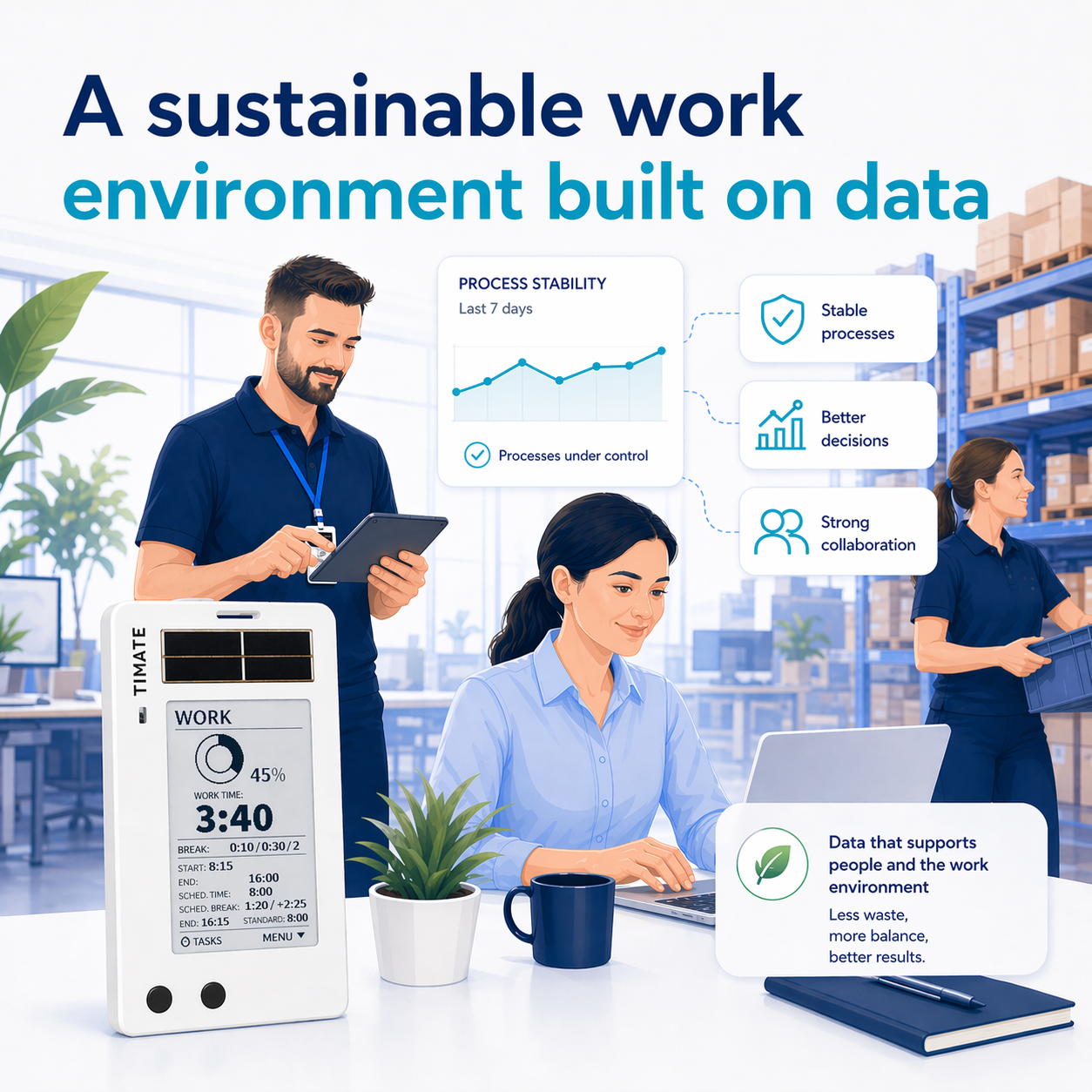
A sustainable work environment built on data

      Companies increasingly expect data to provide not only reports, but real support in building a better work environment. This means moving to a model in which information helps design more stable, predictable, and responsible processes, while also supporting the quality of cooperation and operational decisions.

In practice, a sustainable work environment means conditions in which an organization can combine efficiency with responsibility toward people. Data can show where a process is overloaded, where organizational losses occur, and where changes are needed in communication or team work arrangement. The greatest value appears when information does not stop in a manager’s report, but returns to the organization as a concrete process improvement.

TIMATE was designed around exactly this logic: data should support decisions, not replace people. Thanks to this, the system can help both managers and employees better understand what is happening in the company. This approach builds greater operational transparency and strengthens a culture of responsibility and cooperation.

For a business client, this is a very practical benefit. The company does not have to choose between efficiency and an ethical approach to the team. A well-designed data system can support both goals at the same time.


2022-08-24

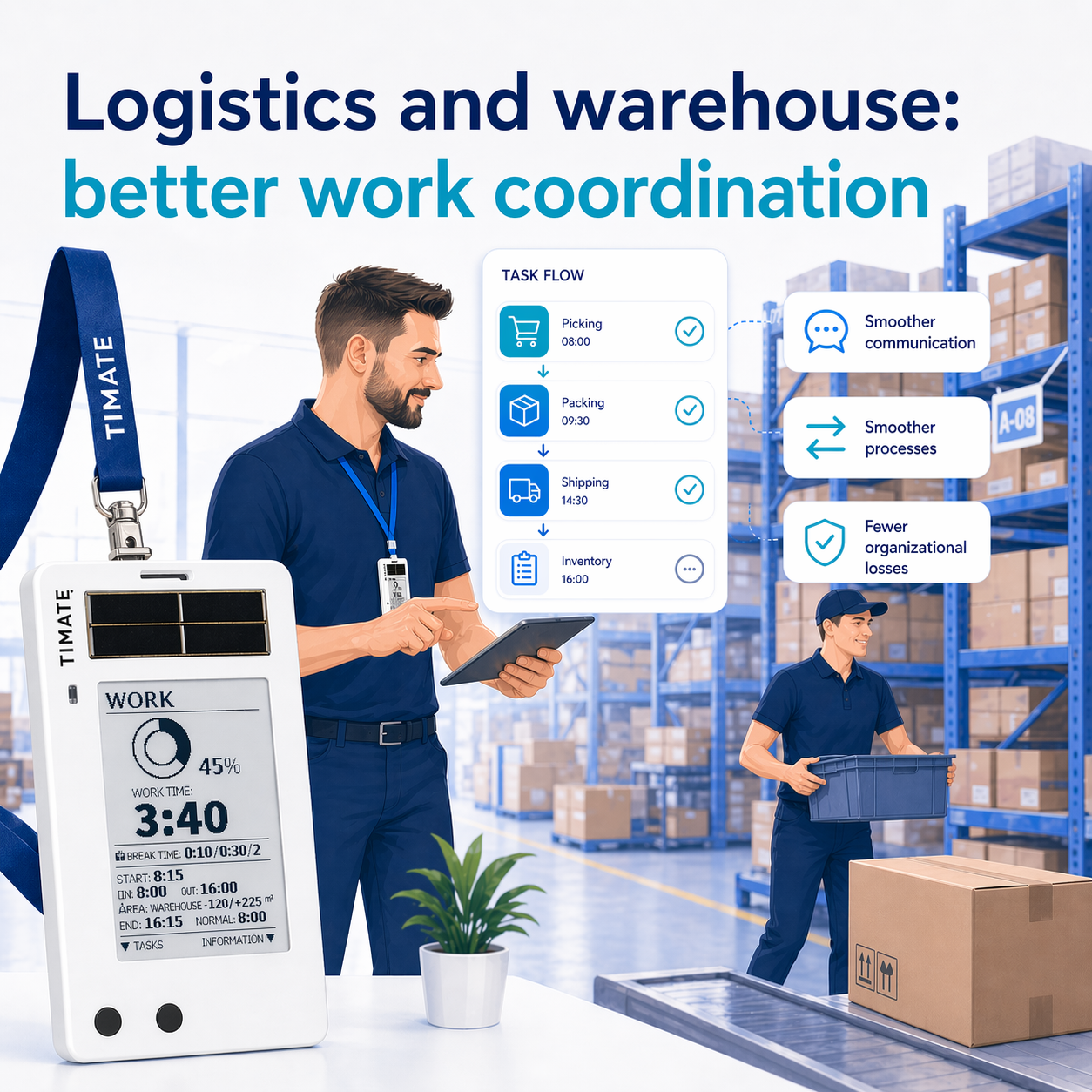
Logistics and warehouse: communication and better work coordination

      The logistics sector is one of those areas where even small organizational disruptions quickly translate into costs, delays, and lower service quality. That is why logistics companies need solutions that combine time recording, communication, and operational data into one coherent management model.

In warehouse and logistics environments, smooth information flow between the office, team leaders, and operational staff is especially important. The speed and clarity of communication directly affect the pace and quality of task execution. When this is combined with a transparent picture of time utilization and better activity coordination, a company can reduce organizational losses more effectively and improve process flow.

From the client’s perspective, this is an important topic because it presents TIMATE not only as a working-time recording system, but as a tool supporting day-to-day process organization. It is precisely in such environments that it becomes clear that operational data gains value when it helps make decisions faster and organize cooperation between teams.

This approach builds competitive advantage in a steady but lasting way: through reducing organizational losses, better use of resources, and greater work predictability. It is a language that is clear both to operations teams and to management.


2022-04-05

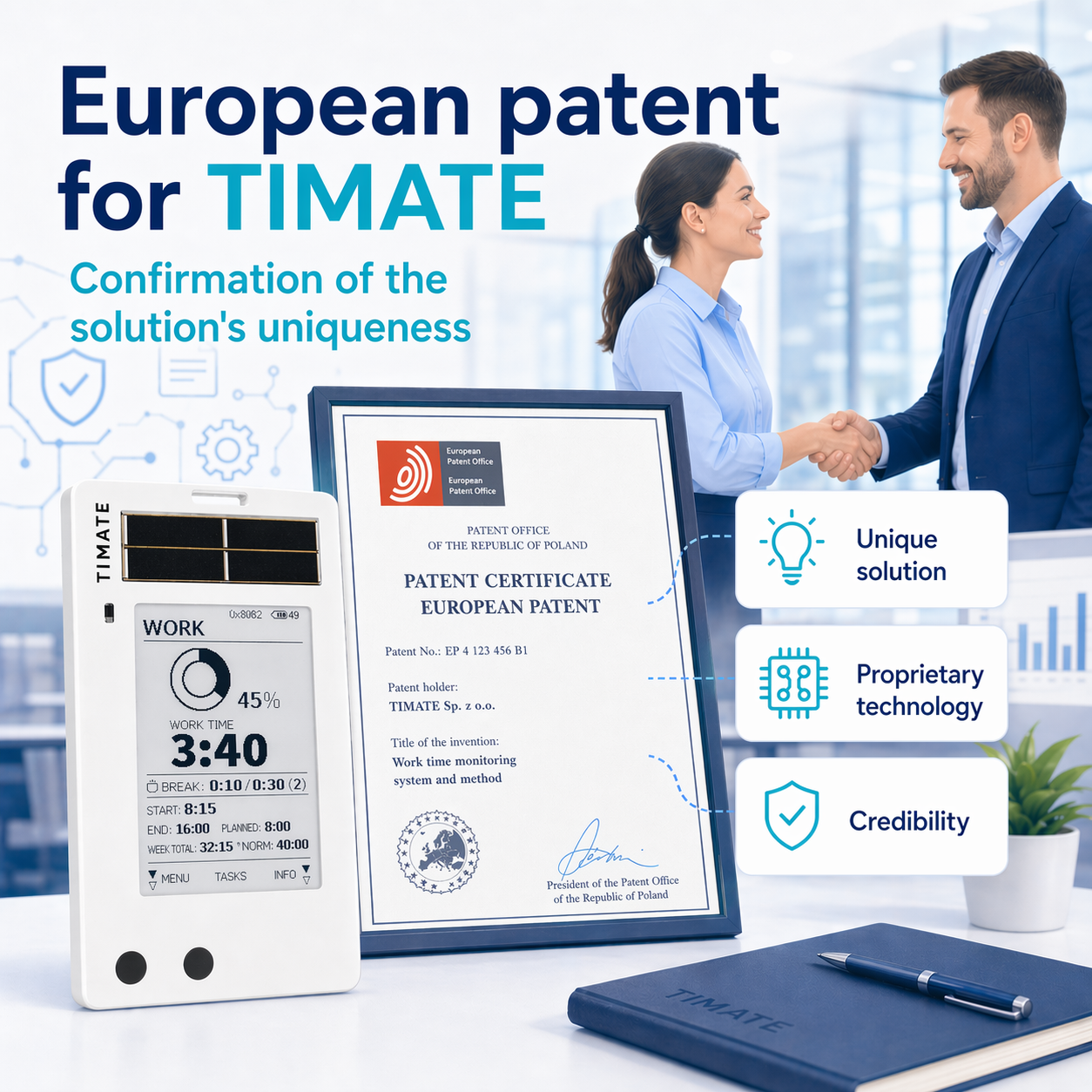
European patent for TIMATE: confirmation of the solution’s uniqueness

      In B2B technology, advantage does not come only from an interesting idea. What also matters is whether the solution is truly unique, difficult to copy, and substantively defensible. The granting of a European patent for the TIMATE system was important precisely for this reason: it confirmed that the developed method and solution architecture are innovative on a market scale.

From a business perspective, a patent increases the product’s credibility. For clients, it means they are working with a company that does not rely on a simple combination of known components, but develops its own approach to automatic working-time registration and support for process organization. For business partners and integrators, it is a signal that they are dealing with a solution with lasting technological advantage.

It is equally important that the development of TIMATE technology has from the beginning been linked to research and development work and consultations with scientific institutions. Such a development model strengthens product quality and allows its use to be better justified in the practice of industrial, logistics, and service companies.

A patent is therefore not only an image message. It is a concrete sales argument: confirmation that the client is investing in a proprietary, refined solution developed with a long-term horizon.


2022-02-23

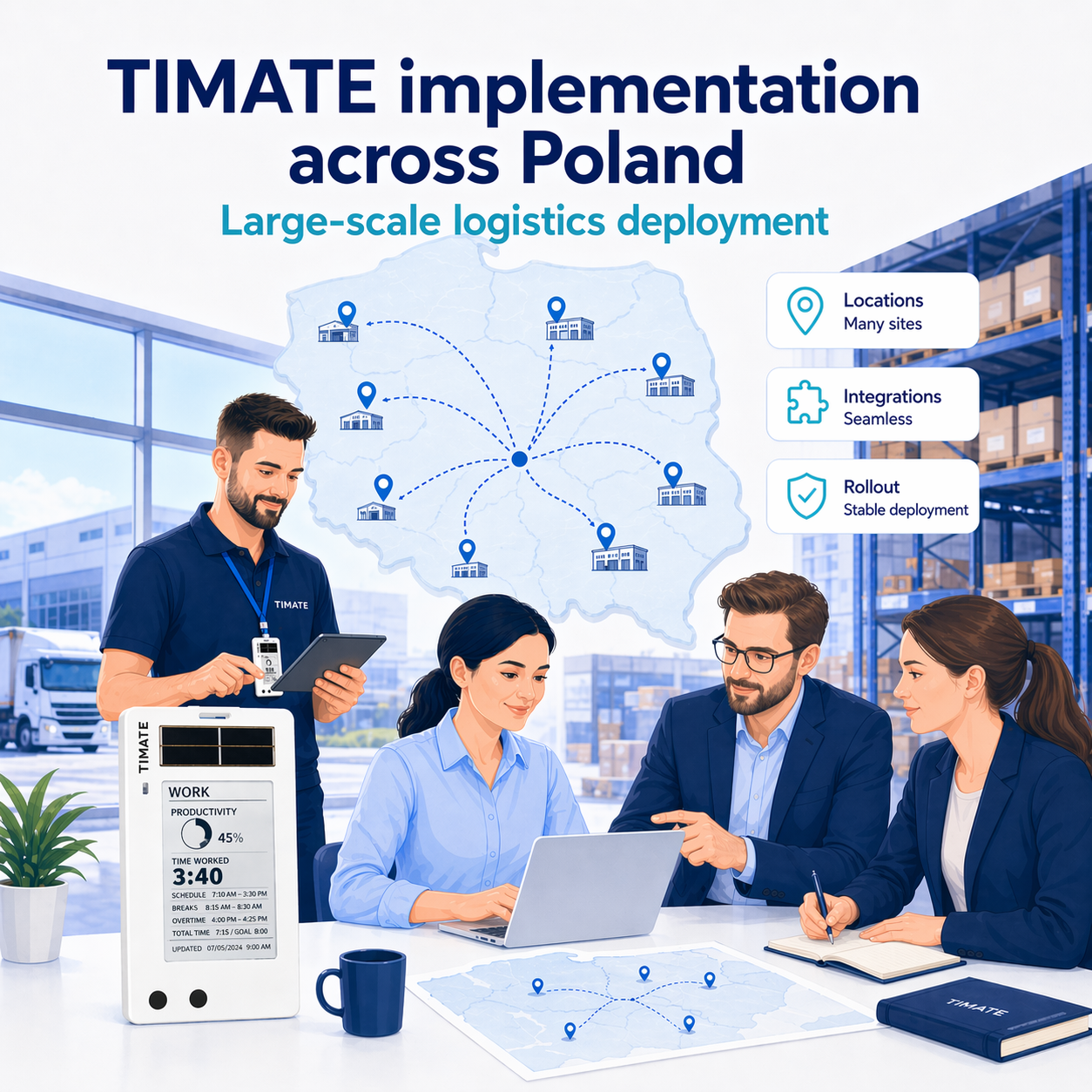
Raben Logistics: TIMATE implementation across Poland

      Implementing technology in a large, distributed organization is the best test of its maturity. That is why the project carried out for Raben Logistics Polska has special reference value. The TIMATE system was implemented there in many locations across the country, integrated with existing HR and working-time planning solutions.

This is an important example for companies looking not only for a tool itself, but for a complete implementation model: from infrastructure preparation, through integrations, to application configuration and launch in operational facilities. This kind of comprehensiveness matters in large organizations, where project success depends on cooperation between technical, operational, and administrative teams.

From the client’s perspective, scale is also key. The solution must be stable, predictable, and ready to work in a multi-site environment. The implementation at Raben shows that TIMATE can serve as a platform supporting not only working-time recording, but also more efficient process management across the entire organization.

For management and operational departments, this is a signal that the system has been tested in a demanding logistics environment. For potential clients, it shows that TIMATE is ready both for pilot implementations and large-scale projects.


2022-02-09

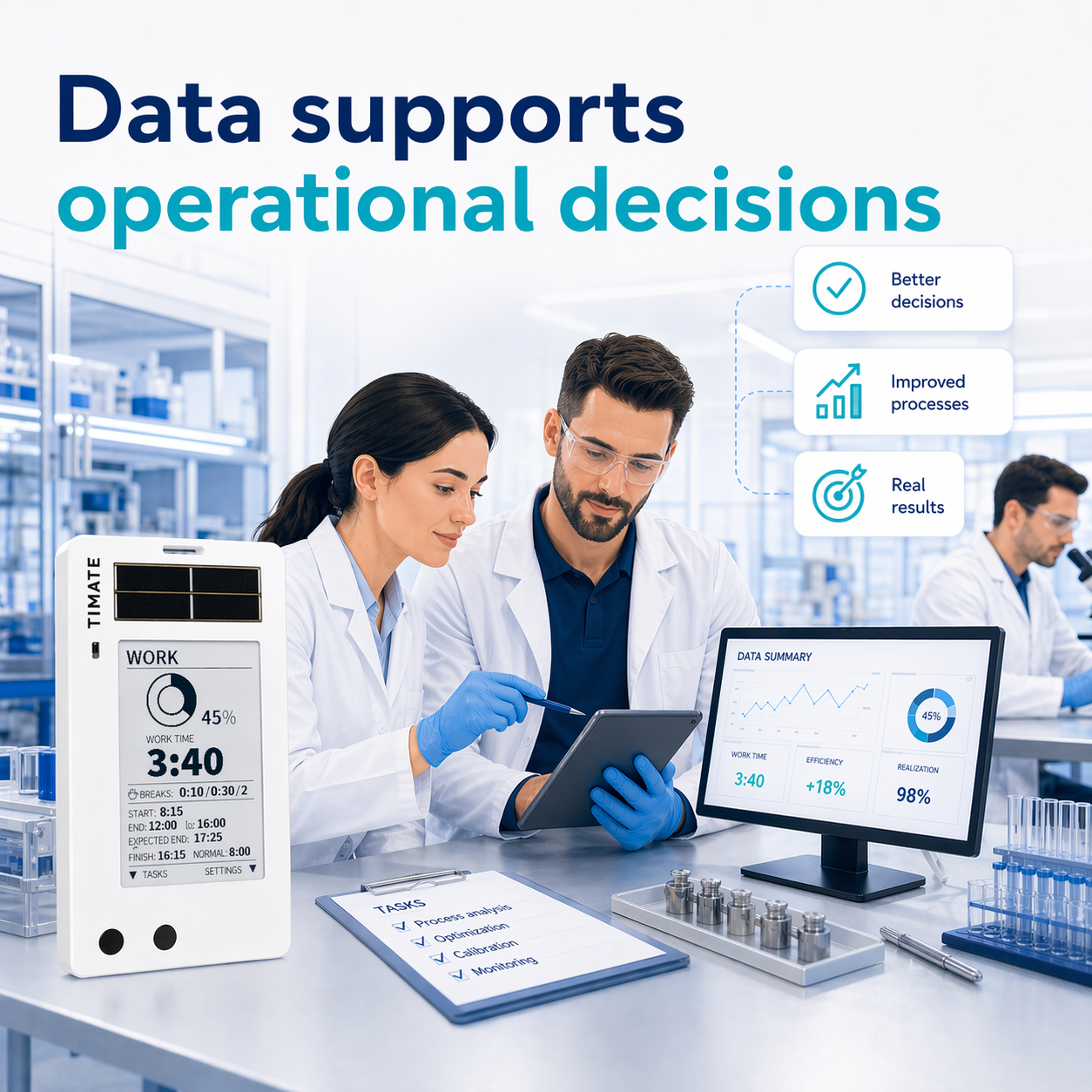
ALAB Laboratories: data that translates into operational decisions

      The most convincing implementations are those in which system data leads to specific organizational changes. This was exactly the nature of the project carried out with ALAB Laboratories. The company used TIMATE to analyze process flow and identify areas that could be improved in the daily work of laboratories.

The strength of this implementation lies in its practical effect. The collected information was not locked away in a report, but became the basis for operational decisions, including better workstation equipment and more efficient allocation of resources. This shows that the value of the system does not end with observing processes. Real value begins when a company can use data to introduce change that improves how the organization works.

This approach is particularly important in environments where speed, precision, and repeatability of processes matter. Laboratories, like logistics and manufacturing, require tools that organize knowledge about work flow without burdening the organization with additional activities.

For future clients, ALAB is an example of an implementation in which technology supports not theory, but everyday management practice. It is a very clear message: TIMATE helps reveal where a process can be improved — and then helps implement that improvement faster.